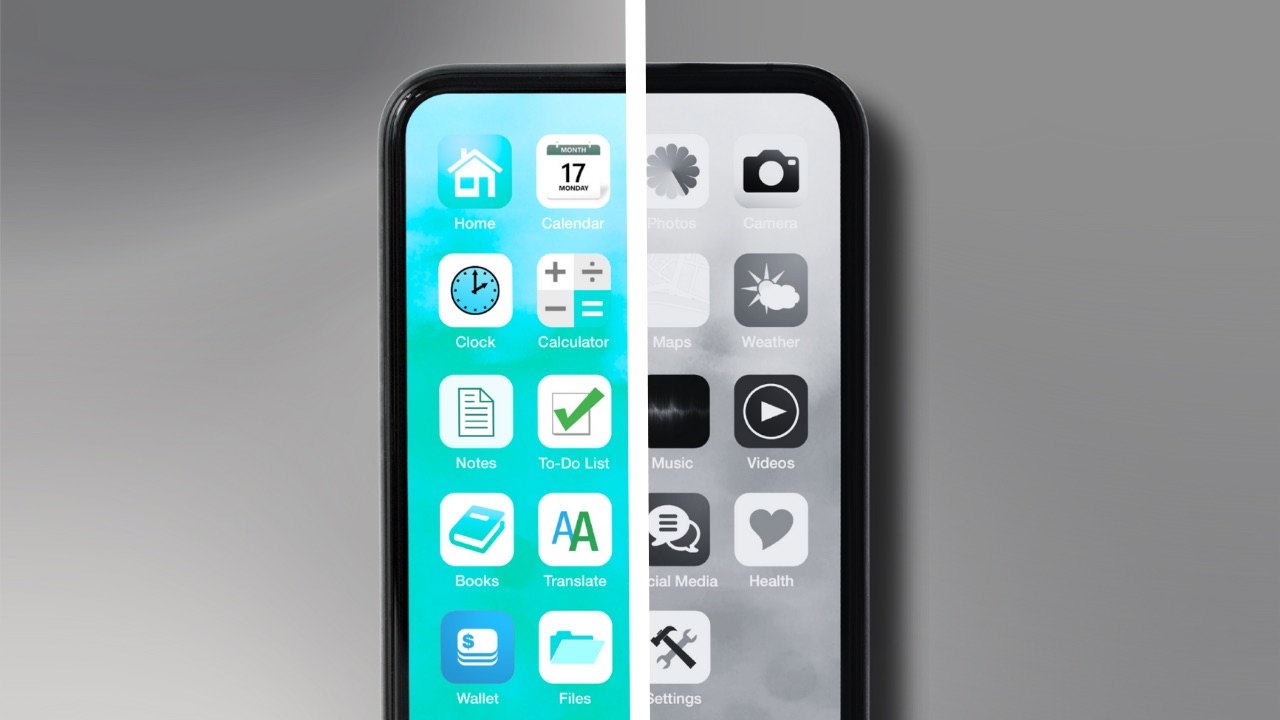
Bright, saturated color is one of the oldest attention magnets the human brain knows. Long before phones, before cities, before writing, color helped keep us alive. Ripe fruit stood out against leaves. Fresh plants looked different from dying ones. Fire glowed. Blood warned. Faces flushed with emotion. The brains that noticed color quickly were the brains that survived.
That wiring never went away, and modern phones exploit it.
When you unlock your phone, you are not entering a neutral information space. You are stepping into a carefully engineered visual environment that exploits the brain's built-in shortcuts for attention. Vibrant app icons. Red notification badges. Electric blues and greens. Each one taps into an ancient bias that says: pay attention to me.
The Science of Attentional Salience
Behavioral psychologists call this attentional salience. Bright, high-contrast stimuli automatically rise to the top of your awareness, before conscious thought kicks in. You do not decide to notice them. Your visual system does it for you.
Once attention is captured, the next system takes over: reward.
Color does not just attract attention. It helps train habits. A red badge might mean a message from someone you care about, or it might be nothing important at all. That uncertainty is the point. Unpredictable rewards trigger stronger dopamine responses than predictable ones. The brain learns that checking could pay off, so it keeps checking.
Over time, this becomes automatic. Red means urgency. Blue means trust. Green means progress. Your brain stops evaluating and starts reacting. The loop closes faster every day.
This is why so many people feel like their phone is "pulling" them in, even when they do not want to check it. The pull is not weakness or lack of discipline. It is conditioning.
The Surprising Solution
Now here is the surprising part.
You can break a large portion of this loop instantly, without deleting apps, blocking websites, or swearing off technology entirely.
You can remove the color.
Turning your phone to grayscale strips apps of their most powerful psychological lever. Without color, notifications lose urgency. Feeds lose contrast. Icons stop competing for attention. The screen becomes informational rather than stimulating.
This works because grayscale does not fight your brain. It works with it.
When the visual system no longer sees biologically meaningful signals, attention drops naturally. Dopamine responses flatten. Scrolling feels slower, less rewarding, and easier to stop. Not because you are forcing yourself to stop, but because there is less incentive to continue.
In experiments and habit-change studies, reducing sensory stimulation consistently lowers compulsive engagement. The brain is always balancing effort and reward. When the reward fades, behavior follows.
People who switch to grayscale often describe the same experience. They still use their phone when they need to. Maps still work. Messages still send. But the urge to check constantly weakens. Doomscrolling feels oddly tedious. Social feeds lose their grip.
The phone does not become useless. It becomes boring.
And boredom, it turns out, is a feature.
Why Boredom Works
One reason grayscale is so effective is that it removes the feeling of deprivation. You are not banning yourself from anything. You are simply changing the environment so that the habit loop has nothing to grab onto. The brain adapts quickly when stimulation drops. What once felt irresistible starts to feel optional.
There is also a deeper effect that spreads throughout the rest of your life. Without constant color-driven novelty, slower rewards regain their appeal. Reading becomes easier. Working feels less fragmented. Even idle moments become tolerable again. The brain remembers how to sit with less stimulation without panicking.
This is why grayscale often works better than strict blockers alone. Blocking relies on willpower and rules. Grayscale changes the emotional texture of the experience itself.
Of course, grayscale is not magic. It will not fix everything. Apps are still designed to be sticky. Content is still infinite. But it removes a major accelerant from the fire.